Adversarial Dynamics Priors for Humanoid
Perturbation-resilient humanoid locomotion via adversarial dynamics-feature regularization.
Duration: 2026.01 - 2026.07
Project Overview
This project proposes Adversarial Dynamics Priors (ADP) for perturbation-resilient humanoid locomotion. Existing motion prior-based methods (e.g., AMP) induce natural motion styles by imitating kinematic motion features, but they do not directly regularize dynamics features such as center-of-mass (CoM) motion, centroidal momentum, contact forces, and contact states. ADP replaces the kinematic motion-style feature with dynamics features extracted from SRBD-based trajectory optimization as the target of adversarial regularization.
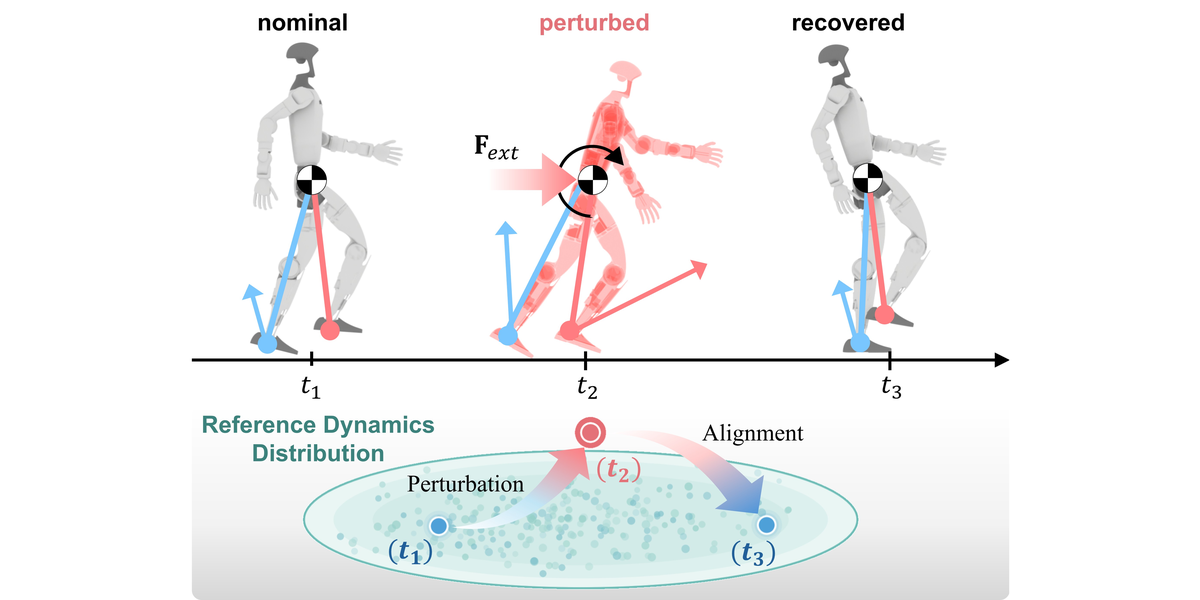 Fig 1. Dynamics-feature alignment for perturbation recovery. An external push drives the humanoid's dynamics features away from the reference distribution; ADP regularizes them back toward this distribution.
Key Methodology
The framework consists of two stages:
- (a) Offline reference generation. SRBD-based trajectory optimization generates physically consistent locomotion trajectories (walking, running, backward, lateral stepping, turning). Dynamics features — CoM velocity, centroidal angular momentum, foot contact forces, and contact indicators — are extracted to build the reference dataset Ddyn.
- (b) Adversarial training. During policy training, temporal dynamics-feature windows from policy rollouts are compared against Ddyn by a discriminator, whose output becomes the dynamics-prior reward.
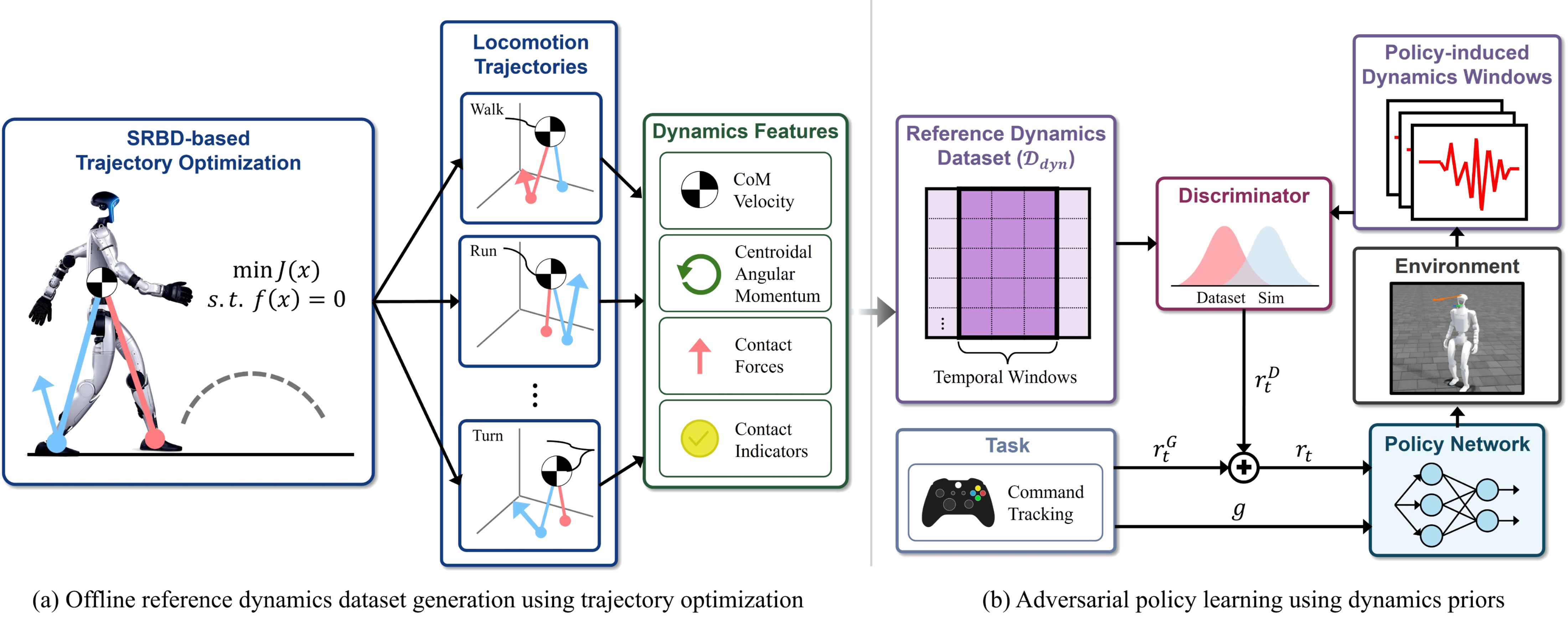 Fig 2. ADP framework. SRBD-based trajectory optimization builds the reference dynamics dataset, and a discriminator provides the dynamics-prior reward during PPO training.
Reference Locomotion Dataset
The reference set covers multiple locomotion modes generated by SRBD trajectory optimization, physically grounded at the SRBD level without imposing full-body joint-tracking targets.
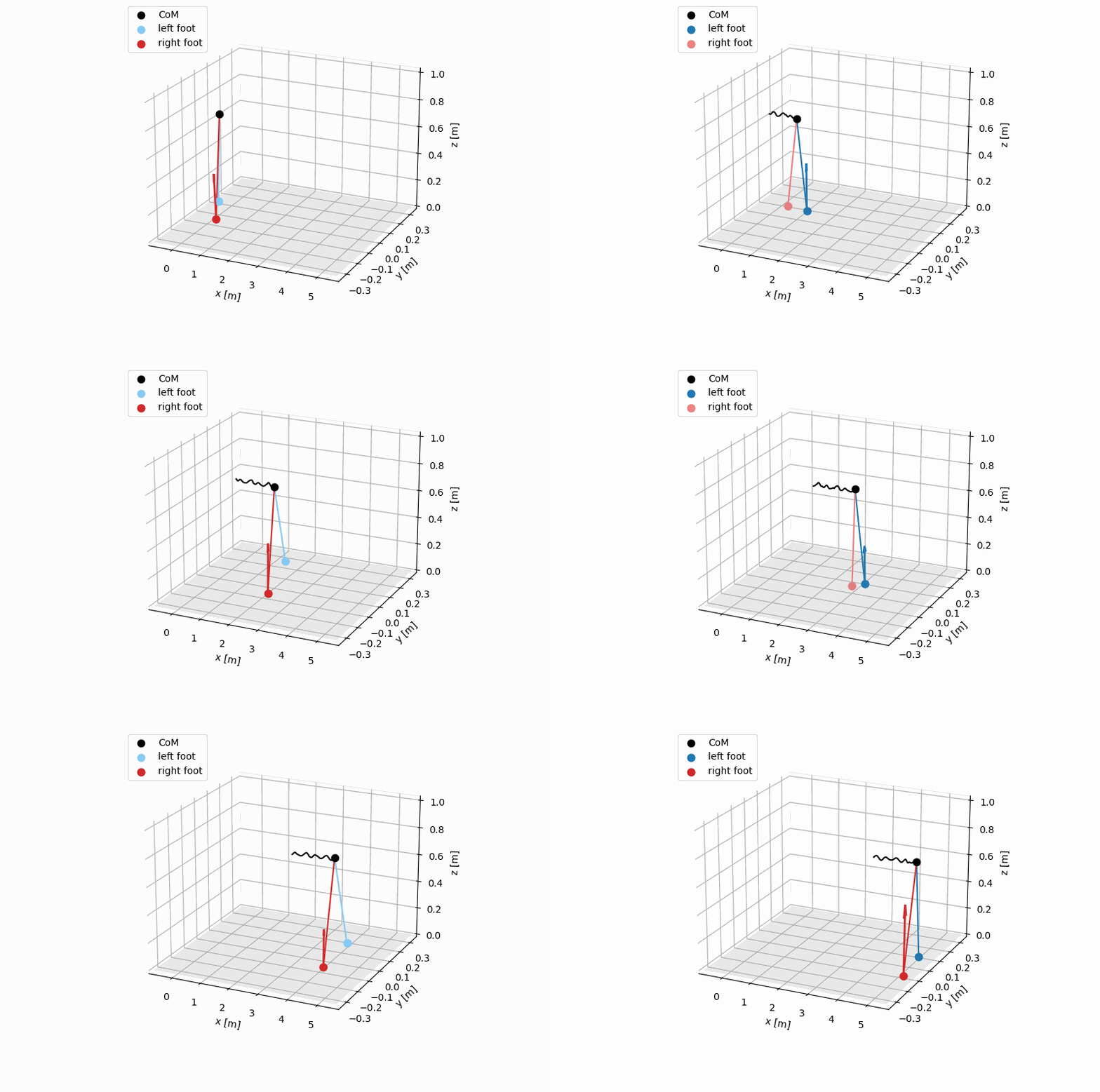 Video 1. SRBD forward walking trajectory used as reference.
Summary Video
Results
Compared with AMP under identical PPO settings, observations, actions, domain randomization, and perturbation curriculum, ADP delivers substantial gains in perturbation recovery:
- Success rate: 91.4% (+18 pp vs. AMP)
- 80%-success impulse threshold (J80): +16.7% vs. AMP
- Direction-averaged recovery time: 2.48 s vs. 4.76 s (−47.9%)
- Velocity-tracking error: 0.84 m/s vs. 1.30 m/s (−35.4%)
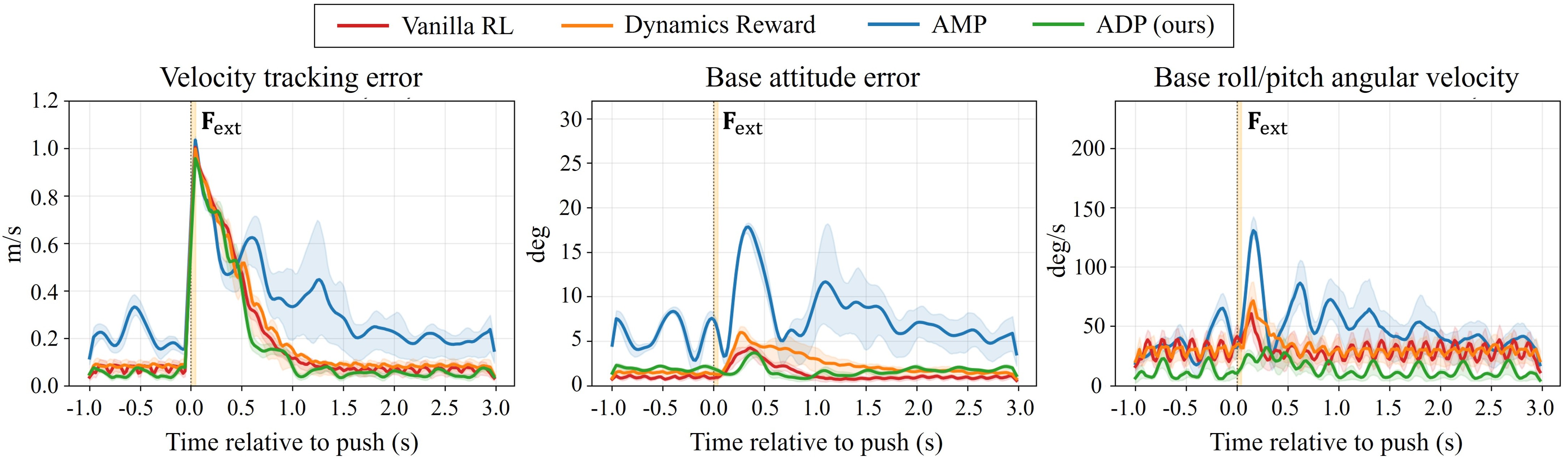 Fig 3. Time-series perturbation recovery under a lateral push. ADP (green) rapidly attenuates transient velocity and attitude errors within ~1–1.5 s.
The approach was also validated on a Unitree G1 humanoid under both instantaneous impulse pushes and continuous sustained forces, isolating the effect of the dynamics prior versus the kinematic motion-style prior.
Acknowledgement
This work was supported by R&D Project of Korea Institute of Machinery and Materials (No. NK261A).
BibTeX
@article{lee2026adp,
  title   = {ADP: Adversarial Dynamics Priors for Physically Grounded Humanoid Locomotion},
  author  = {Lee, Seokju and Lee, Jeongtae and Lim, Jeonghyeok and Kang, Jeonguk and
             Lee, Byungwook and Han, Seungho and Choi, Keun Ha and Park, Dongil and Kim, Kyung-Soo},
  journal = {arXiv preprint arXiv:2607.03454},
  year    = {2026}
}