Interworking control for a Lower Limb Exoskeleton
Position-based knee-hip interworking control for a lower limb exoskeleton in lifting assistance
Duration: 2024.01 - 2024.12
Project Overview
This research focuses on enhancing the lifting capabilities of industrial lower-limb exoskeletons. Specifically, it addresses the challenge of providing hip support in exoskeleton systems that are primarily actuated at the knee but have passive or under-actuated hip joints.
The project proposes a Position-based Knee-Hip Interworking Control strategy that leverages the natural kinematic coupling between the knee and hip joints during squat lifting motions.
 Fig 1. Exoskeleton System
Key Research & Methodology
1. Kinematic Correlation Analysis
We analyzed human motion data during lifting tasks to establish a linear correlation between knee extension and hip extension. This correlation serves as the foundation for predicting the necessary hip support based on knee motion.
2. Interworking Control Strategy
Instead of adding heavy actuators to the hip, this project utilizes the actuators at the knee to indirectly support the hip joint.
- Concept: By controlling the knee joint based on the desired hip-knee relationship, the system manipulates the Ground Reaction Force (GRF) vector.
- Mechanism: The controller generates an assistive torque at the knee that creates a moment arm effective enough to reduce the load on the user’s lower back (lumbar spine) during the lifting phase.
3. Verification
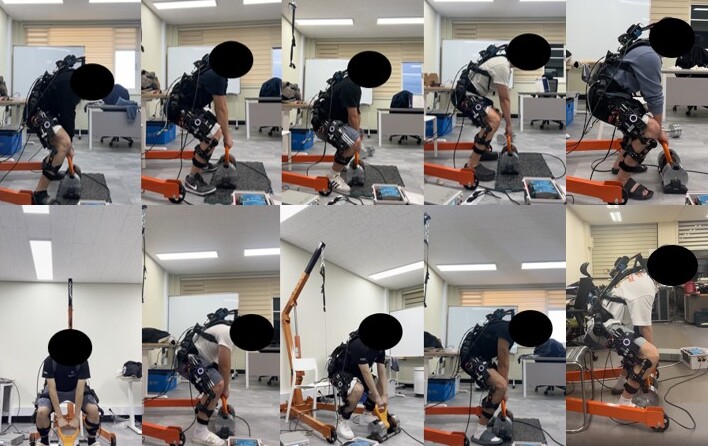 Fig 2. Experiment Setup
The effectiveness of the proposed control method was verified through surface Electromyography (sEMG) analysis.
- Experiments: Subjects performed lifting tasks with and without the proposed control.
- Results: The system demonstrated a reduction in muscle activity in key muscle groups, particularly the Erector Spinae and Gluteus Maximus, confirming that the knee actuation successfully compensated for the lack of active hip torque.
Acknowledgement
This research was financially supported by the Institute of Civil Military Technology Cooperation and funded by the Defense Acquisition Program Administration and Ministry of Trade, Industry and Energy of the Korean government under grant No. 19-CM-GU-01.